 Zadano
The household
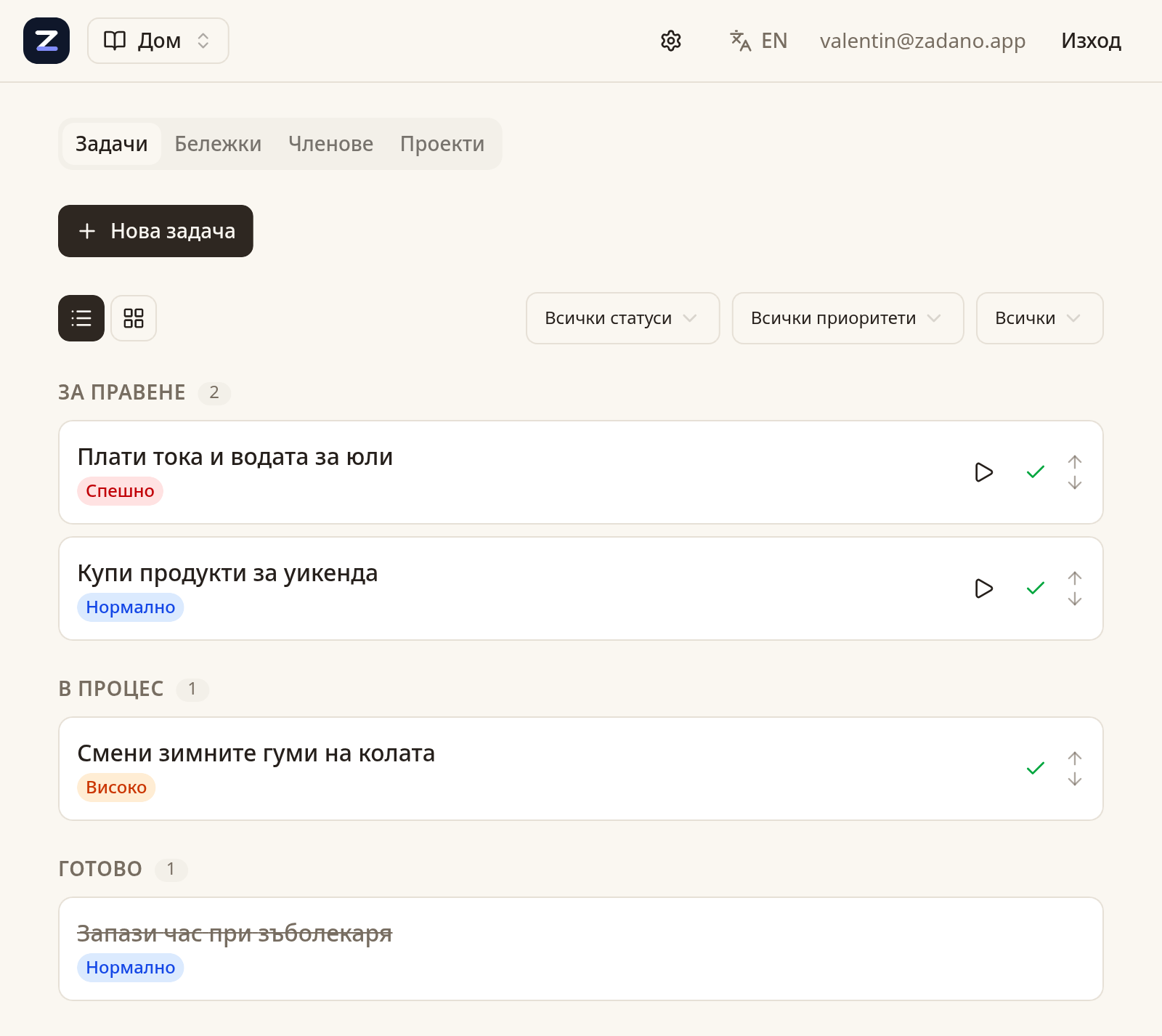
A shared list with the family: bills, groceries, repairs. Everyone sees what the other picked up, nothing drowns in chat threads.
Pay the July electricity billBuy groceries for the weekendSwap the winter tires
Zadano keeps the tasks, notes and people from every part of your life in one place. Strictly separated. Updated in real time.
Every context lives in its own workbook: with its own people, teams, tasks and notes. Your spouse sees Home, but not the company. An employee sees their department, but not the accounting.
For the household, for each company, for the team. As many contexts as you run, that many workbooks you make.
Roles for a quick start, eight fine-grained flags for tuning: who sees everything, who sees only their own, who assigns and who manages teams.
A task with priority, due date and status. A project for bigger things, a note for everything else. Every change stays in the history.
A shared list with the family: bills, groceries, repairs. Everyone sees what the other picked up, nothing drowns in chat threads.
Two partners, clients and deadlines. A separate workbook, separate people, no mixing with private life.
Thirty people in teams with leads. A manager distributes to a whole department in seconds; each employee sees only their segment.
A workbook just for you: goals, ideas, small stuff. The same tool, zero noise from your other worlds.
Roles to start, fine-grained flags on top: who reads everything, who creates, who assigns to others, who manages teams and members. The check runs on the server, on every request.
allow write: if member.can('assignOthers');
allow read:  if isolated(workbook);
Departments with leads and sub-teams. A lead sees their branch of the hierarchy, the owner sees everything.
Created, assigned, completed with a note: every step records who and when. History cannot be edited.
Checklists, agreements and know-how live next to the tasks, under the same access permissions. Pin what matters.
Optionally, tasks become quests with XP and a member leaderboard. Serious work doesn't have to be boring.
Security first
Access is decided by rules inside the database itself, not by the interface. Deny by default: whatever is not explicitly allowed is forbidden.
94 automated tests verify on every change that a member of one workbook cannot read another. A failing test means a stopped deploy.
Data lives in a European region of Google Cloud. No ads, no trackers, with your GDPR rights: access, correction, erasure. Privacy policy.
Write a meeting note, press "Analyze" and Zadano suggests tasks and updates. You review and approve each one: the AI never writes into the workbook by itself.
The feature is off by default and runs only with your own API key. The key stays in your private space, requests go directly to your chosen provider and are billed to you. Zadano stores neither the requests nor the responses. Read the full AI statement.
Yes. Every feature is free, with no ads and no tracking. No card required.
Access is checked on the server by security rules, not just in the interface. A member of one workbook has no technical way to read data from another, even through the API. The rules are covered by 94 automated tests.
People who run several parallel contexts: a household, one or more companies, a team with departments. Each context is a separate workbook with its own members and permissions, and you see them all with one account.
Yes. Zadano is a PWA: it opens in any browser and installs to the home screen on Android and iPhone, no app store needed. The cache covers short connection drops.
AI is off by default and runs only with your own key from Anthropic, OpenAI or Google. Only the text of the note you explicitly analyze is sent, plus the titles of open tasks in scope. You pay the provider directly; Zadano does not store the requests. Details in the AI statement.
Yes, at any time, in line with GDPR. Write to valentin.k.kirilov@gmail.com and the account with its personal data is removed. Data is stored in the European Union.
Free, no card, in English and Bulgarian. Works on your phone and your computer.
Start free